5.3 烯烃羟卤化反应制备邻卤醇
次卤酸对烯烃的加成,生成邻卤醇,其反应本质及选择性相同与卤素加成反应。卤素正离子首先对烯烃的双键作亲电进攻,生成桥卤三元环过渡态,然后,水分子或羟基对其亲核进攻,得到邻卤醇。按照马氏规则,卤素加成在双键的取代基较少的一端。
 应用次卤酸酯(ROX)作为卤化剂,其机理相同于次卤酸的反映,但是可在非水溶液中进行反应。根据溶剂的亲核基团不同,可生成相应的-卤醇β衍生物。

 5.3.1
烯烃羟卤化反应制备邻卤醇示例
5.3.1
烯烃羟卤化反应制备邻卤醇示例
 Under vigorous agitation and cooling to 0.deg.-5.deg. C., 150 g of chlorine is introduced within 6 hours into a solution of 182 g of cis-1,4-dihydroxy-2-butene and 288 g of crystallized soda (Na2CO3 *10H2O).. The mixture is stirred for another hour, concentrated under vacuum at 50.deg.-55.deg. C., and diluted with 0.6 l of ethanol.. After standing overnight, the mixture is filtered off from sodium chloride and thoroughly washed with ethanol. The solution and the filtrate are concentrated, thus obtaining 3-chloro-1,2,4-butanetriol as a yellow oil. Yield: 272 g (97percent of theory) of 3-chloro-1,2,4-butanetriol.
5.4
Kennedy oxidative cyclization
Under vigorous agitation and cooling to 0.deg.-5.deg. C., 150 g of chlorine is introduced within 6 hours into a solution of 182 g of cis-1,4-dihydroxy-2-butene and 288 g of crystallized soda (Na2CO3 *10H2O).. The mixture is stirred for another hour, concentrated under vacuum at 50.deg.-55.deg. C., and diluted with 0.6 l of ethanol.. After standing overnight, the mixture is filtered off from sodium chloride and thoroughly washed with ethanol. The solution and the filtrate are concentrated, thus obtaining 3-chloro-1,2,4-butanetriol as a yellow oil. Yield: 272 g (97percent of theory) of 3-chloro-1,2,4-butanetriol.
5.4
Kennedy oxidative cyclization
Kennedy, R. M.et alfirst reported that 5-hydroxyalkenes react with rhenium (VII) oxide (Re2O7) to provide 2-hydroxymethyltetrahydrofurans in 1992. Oxidative cyclization occurs with overallsynaddition to the alkenes in moderate yields with little tendency toward oxidation of alcohols to carbonyl compounds. Since that this kind of reaction named Kennedy oxidative cyclization. Despite high stereoselectivity, a disadvantage of these reactions is the necessity of a stoichiometric excess of rhenium (VII) oxide needed to force these reactions to completion. The improved method was reported that 5-hydroxyalkenes react with catalytic amounts of rhenium (VII) oxide (Re2O7) in the presence of another oxidant, H5IO6, to provide substituted tetrahydrofurans.
 5.4.1
Mechanism
5.4.1
Mechanism
 5.4.2
General procedure
5.4.2
General procedure
5.4.2.1 React with the stoichiometric excess of rhenium (VII) oxide .
To a solution of 1 mmol of 5-hydroxyalkenes and 1.1 mmol of 2, 6-lutidine in 5 ml of methylene chloride at room temperature was added 1.1 mmol of Re2O7.The rhenium (VII) oxide dissolved rapidly providing a red solution that gradually yielded a black precipitate as the reaction proceeded. After 1 hr, 1.1 mmol of 2, 6-litidine followed by 1.1 mmol of rhenium (VII) oxide were added. This sequence was repeated again after another hour. After 8 hrs, 10 mmol of sodium hydroperoxide was added as a 1 M aqueous solution. The resulting colorless mixture was stirred for 30 minutes, and then diluted with 10 ml of methylene chloride. The organic layer was washed with 10 ml of 1 N HCl to remove 2, 6-lutidine followed by 10 ml of saturated NaCl solution. The products were then purified by flashchromatography on silica gel.
5.4.2.2 React with catalytic amounts of rhenium (VII) oxide (Re 2 O 7 ) in the presence of another oxidant, H 5 IO 6 .
To a mixture of 1.0 mmol of 5-hydroxyalkene and 1.3 mmol of periodic acid (H5IO6) in CH2Cl2at room temperature, was added 0.5 mmol rhenium (VII) oxide (Re2O7). The reaction was monitored by TLC until all starting material was consumed (about 15 hr). Then, 10 equivalents of NaHSO3as 1.0 M aqueous solution was added. After stirring for 30 min, the reaction mixture was diluted with CH2Cl2and the product was purified in normal fashion. 5.5 Baylis-Hillman reaction
5.5 .1 Introduction
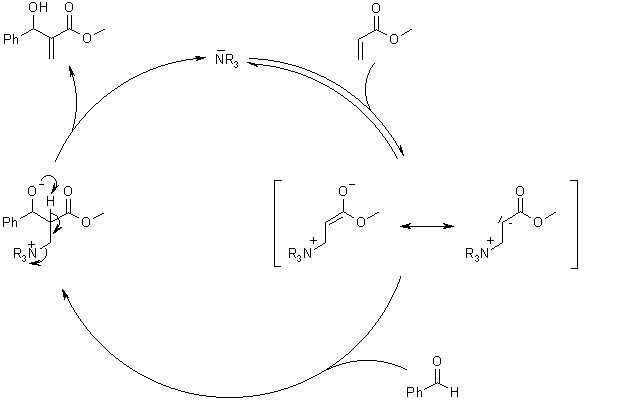
The base-catalyzedreaction of activateda,b-unsaturated vinyl systems with suitable electrophiles (generally aldehydes) affords useful synthetic intermediates. When the base are tertiary aminesespeciallydiazabicyclo[2,2,2]octane (DABCO), the sequence has frequently been referred to as the Baylis-Hillman reaction. Baylis and Hillman first described the reaction betweena,b-unsaturated esters, nitriles, amides or ketones with a broad spectrum of aldehydes in 1972. Now it is an elegant route to multifunctional products. The key limitation of the reaction is the slow reaction rate, which entails prolonged reaction times. There have been a number of substantial contributions to improving the reaction rates including the use oh phosphines as catalysts, Addition of Lewis acid, high pressure, ultrasound and microwave irradiation.
 5.5.2
Mechanism
5.5.2
Mechanism
5.5.3 General procedure
 Benzaldehyde (5 mmol) and methyl acrylate (5.5 mmol) were added to a round-bottomed flask containing the phosphonium salt (0.5 mmol) and DBACO (2.5 mmol). The flask was stoppered and the mixture was stirred at room temperature for 24 h. the mixture was diluted with DCM (10mL) and washed successively with aq. HCl (2M) and water. The organic phase was dried and concentrated. The residue was purified by flash chromatography (ethyl acetate/ hexane, 1:3) to givemethyl3-hydroxy-2-methylidene-3-phenylpropionate.
5.5.4 References
1.Baylis, A. B.; Hillman, M. E. D. Ger. Pat. 2, 155,113, ( 1972 ).
2.Drewes, S. E.; Roos, G. H. P.Tetrahedron 1988 ,44, 4653.
3.Basavaiah, D.; Rao, P. D.; Hyma, R. S.Tetrahedron 1996 ,52, 8001.
4.Ciganek, E.Org. React. 1997 ,51, 201. (Review).
5.Shi, M.; Feng, Y.-S.J. Org. Chem. 2001 ,66, 406.
6.Kim, J. N.; Im, Y. J.; Gong, J. H.; Imaeda, K.Tetrahedron Lett. 2002 ,42, 4195.
7.Shi, M.; Li, C.-Q.; Jiang, J.-K.Helv. Chim. Acta 2002 ,85, 1051.
8.Yu, C.; Hu, L.J. Org. Chem. 2002 ,67, 219.
9.Wang L.-C.; Luis A. L.; Agapiou K.; Jang H.-Y.; Krische M. J.J. Am. Chem. Soc. 2002 ,124, 2402.
10.Frank, S. A.; Mergott, D. J.; Roush, W. R.J. Am. Chem. Soc. 2002 ,124, 2404.
11.Shi, M.; Li, C.-Q.; Jiang, J.-K.Tetrahedron 2003 ,59, 1181.
12.Johnson C. L.et al.Tetrahedron Lett. 2004 ,457359.
🔙返回上一页🔙